Workforce data
Employee ZIP codes, ages, and individual or family coverage needs
When it comes to benefits funding options, more and more employers are comparing Individual coverage HRAs to group health plans. Choosing the best option depends on your business. Get the facts so you can make an informed decision.
Traditional group health insurance is a defined benefits model, and ICHRA is defined contribution model. The main structural differences are who chooses the plan, how payments are made, and the pricing structure.
|
Traditional Group Health Insurance |
ICHRA (now called CHOICE Arrangement) |
|
|---|---|---|
|
Model |
Defined benefits |
Defined contributions |
|
Plan selection |
The employer chooses the healthcare plan for the company |
Employees choose their own plan from healthcare.gov or a state marketplace |
|
Payments |
The employer pays a percentage of the premium |
The employer allocates a monthly allowance for employees |
|
Pricing |
Variable: Determined by carrier, claims history, and risk pool |
Fixed: Determined by employer |
Group health insurance: The employer selects a plan and pays a share of the employee premium.
ICHRA: The employer sets a fixed monthly allowance for employees to buy their own plan.
When you’re considering an individual coverage HRA vs. a group health plan, there is a lot at stake. Neither is inherently better, it’s what works best for your business.

|
Decision factor |
Traditional Group Health Insurance |
ICHRA (now called CHOICE Arrangement) |
|---|---|---|
|
Provider networks |
Employer picks one health plan for the company, so everyone has access to the same list of doctors and hospitals. |
Employees pick their own plan, so access to doctors and hospitals depends on the plan and region. |
|
Geographic adaptability |
Simple for employees in one region, more difficult for multi-state teams. |
Location agnostic; uses the framework chosen by the employer. |
|
Compliance mandates |
ACA compliance mandates are built into the plan options. |
Safe-harbor calculations are used to ensure compliance. |
|
Plan portability |
Tied to employment: Coverage ends when the employee leaves the company. They can elect temporary COBRA coverage at their own expense. |
Owned by the employee: The health policy belongs to the individual. If they leave the company, they can keep the plan at their own expense. |
|
Administrative workload |
Front-loaded during plan renewal: handling carrier negotiations, plan design, and open enrollment. |
Ongoing: reimbursing employee claims, confirming employees still have coverage, and reporting for taxes and payroll. |
|
Employee experience |
Familiar: Employees understand how group plans work. Copays, deductibles, and enrollment follow predictable norms. |
Requires education: Employees learn how to select plans and use allowance, employer learns administrative requirements. |
|
Risk pool |
High employer vulnerability: Risk is shared among the employees on the company’s group plan (e.g. 50 or 100 people). |
Low employer vulnerability: Risk is shared among the number of state participants (e.g. 501,000 people in Pennsylvania or 5.3 million in Florida). |
Group health insurance could be a good fit if:
Employees are concentrated in one area: Your workforce resides primarily in one region with good group rates and high-quality network access.
Individual markets are lacking: Your business operates in a (rural) area where the individual market offers a limited choice of healthcare providers.
Change management would be burdensome: You don’t have the bandwidth or desire to take on a new benefits model and prefer to stay with what you know.
ICHRA could be a good fit if:
Employees live in different states: You don’t want to buy multiple, state-specific group plans or pay extra for out-of-state networks.
A single plan would be limiting: You want your staff (from young singles to older employees with families) to have a health plan that meets their specific needs.
Fixed pricing would help you budget and/or reduce costs: You want to set a monthly health insurance allowance that doesn’t change unless you want it to.
Start your evaluation by compiling:
Employee ZIP codes, ages, and individual or family coverage needs
Plan costs where employees live
Premiums and renewal increases from the past three to five years
Current benefits spending and target contribution budget
Weighing ICHRA against a group plan takes work. It requires running the numbers, understanding compliance, and knowing what actually works for your business.
Take Command is uniquely positioned to support employers. We offer deep health insurance experience and precise data modeling so you can confidently evaluate your benefits options.
And what’s just as important? If ICHRA isn’t a good fit for your business, we’ll tell you. Our goal is to provide information that helps you make a strategic decision.
Talk to a Take Command about ICHRA vs group health insurance. We’ll use real-time market rates to model what you’re paying for group insurance versus what you’d spend with an ICHRA.
2027 rate filings as they’re released
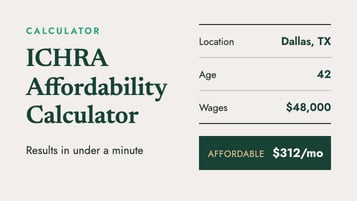
Compliance requirements for allowances
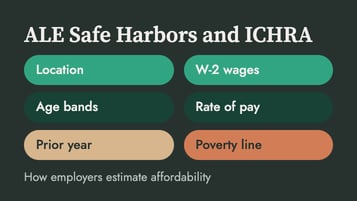
Understanding large employer requirements
Tax savings for employers and employees
States where HRAs are most affordable
Compare and contrast options
We’re on a mission to create a consumer-centric healthcare system.
©2026 Take Command. All Rights Reserved.
Take Command Health is a financial technology company and is not a bank. Banking services are provided by TransPecos Banks, Member of FDIC. FDIC insurance is available for funds on deposit up to $250,000 through TransPecos Banks, Member FDIC. Accounts are eligible for pass-through deposit insurance only to the extent pass-through insurance is permitted by the rules and regulations of the FDIC, and if the requirements for pass-through insurance are satisfied. There may be a risk that pass-through deposit insurance is not available because conditions have not been satisfied. In such cases, funds may not be fully insured in the event the insured depository institution where the funds have been deposited were to fail.
Privacy Policy Terms of Use Trust Center Licensing Sitemap Secured with SSL