Avoid expensive insurance
Florida group health insurance is expensive and forces employers to choose one plan for all employees.
Florida employers: Save up to 31% on health insurance¹
From The 305 to The 850, affordable health insurance in Florida starts with a Take Command HRA
Avoid expensive insurance
Florida group health insurance is expensive and forces employers to choose one plan for all employees.
Set your own budget
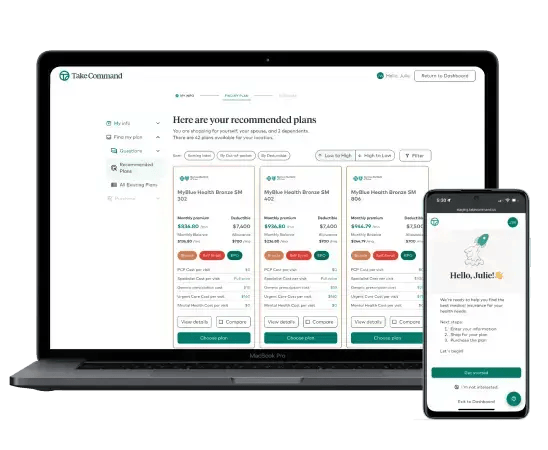
With a Take Command HRA, employers set an employee allowance and employees buy the plan they want.
Save money with an HRA
The cost difference makes a Take Command HRA more affordable for counties throughout Florida.
Florida employers can save up to 31% on health insurance by signing up for a Take Command HRA
The prices below are 2025 average rates for a 50-year-old on a bronze plan.
Small group insurance: $649
Individual health plan: $541
Small group insurance: $614
Individual health plan: $512
Small group insurance: $604
Individual health plan: $440
Explore Florida Health Plans
Browse ACA plans by county to see coverage options, carriers, and pricing your employees can choose from.
What is an HRA?
A Health Reimbursement Arrangement (HRA) is a tax-advantaged health benefits solution where employers give a monthly allowance to employees for qualified medical expenses and insurance premiums. The employer sets the budget, and the employees buy healthcare plans from the ACA or state marketplace.

Florida doesn't have a state income tax, which makes HRA benefits even better for the Sunshine State. Employer contributions are tax-deductible, and employees receive them completely tax-free. This means every dollar you put into an HRA goes further for both your business and your team.
If you’re a health insurance broker with clients in Florida, you could be providing them significant savings with a Take Command HRA.
References:
1. https://ideonapi.com/ideon-ichra-insights-by-state
2. https://www.cms.gov/newsroom/fact-sheets/marketplace-2026-open-enrollment-period-report-national-snapshot
Florida Employer HRA: Frequently Asked Questions
Depending on the county, here are some of the insurance carriers your employees can choose from:
Ambetter
Florida Blue
Molina Healthcare
UnitedHealthcare
HRAs offer a double tax advantage in Florida. Contributions made by the employer are 100% tax-deductible as a business expense, and the reimbursements received by employees are 100% tax-free. This makes every dollar spent on benefits go much further than a traditional salary increase.
Florida has more ACA Marketplace enrollees than any other state in the country, giving it one of the most established individual health insurance markets nationwide. With 16 carriers offering plans for 2026, employees in major metros like Miami-Dade, Broward, and Hillsborough have significant choice, which keeps individual premiums competitive and predictable compared to traditional group plans.
QSEHRA (Qualified Small Employer Health Reimbursement Arrangement): For businesses with fewer than 50 employees that don't offer a group plan. It has set annual contribution limits ($6,450 for individuals / $13,150 for families in 2026). QSEHRA is perfect for Florida small business health insurance.
No, Florida doesn't operate its own state health marketplace exchange. Employees shop for ACA-compliant plans through the federal marketplace at HealthCare.gov, where they can compare and enroll in coverage from any of Florida's participating carriers.
Retail health insurance costs are increasing each year, but HRAs provide affordable coverage for diverse workforces with full-time, part-time, and seasonal staff.

We’re on a mission to create a consumer-centric healthcare system.
©2026 Take Command. All Rights Reserved.
Take Command Health is a financial technology company and is not a bank. Banking services are provided by TransPecos Banks, Member of FDIC. FDIC insurance is available for funds on deposit up to $250,000 through TransPecos Banks, Member FDIC. Accounts are eligible for pass-through deposit insurance only to the extent pass-through insurance is permitted by the rules and regulations of the FDIC, and if the requirements for pass-through insurance are satisfied. There may be a risk that pass-through deposit insurance is not available because conditions have not been satisfied. In such cases, funds may not be fully insured in the event the insured depository institution where the funds have been deposited were to fail.
Privacy Policy Terms of Use Trust Center Licensing Sitemap Secured with SSL